Tag Archives: Kingdom of heaven

Being Good Is Not Good Enough

Matthew 19:16–30: Why We Need God’s Grace, Not Our Goodness

Matthew situates the encounter with the rich young ruler within a broader discourse on the kingdom of heaven (Matthew 19). Jesus’ teachings on marriage (19:1–12) and His welcome of children (19:13–15) prepare the reader to understand that entrance into the kingdom is not achieved through human merit but through divine grace. This theme reaches its climax in the dialogue with the rich young man.

The young ruler’s question—“Teacher, what good deed must I do to have eternal life?” (19:16)—reveals a works‑oriented understanding of salvation. Jesus immediately challenges this assumption: “Why do you ask me about what is good? There is only one who is good.” (19:17; cf. Mark 10:18). By asserting that goodness belongs to God alone, Jesus exposes the man’s misplaced confidence in his own moral performance.

Jesus’ instruction, “If you would enter life, keep the commandments” (19:17), functions not as a path to salvation but as a diagnostic. Scripture consistently teaches that the law cannot justify (Romans 3:23; Galatians 2:16, 3:11). When the man claims, “All these I have kept” (19:20), he demonstrates both sincerity and self‑deception. His obedience is real, but his righteousness is insufficient.

The turning point comes with Jesus’ demand: “If you would be perfect, go, sell what you possess… and come, follow me.” (19:21). Perfection—echoing Matthew 5:48—is not moral flawlessness achieved through human effort but wholehearted allegiance to Christ. The man’s wealth is not condemned in itself; rather, his attachment to it reveals the deeper obstacle: he trusts his own goodness and security more than he trusts God.

The disciples’ astonishment—“Who then can be saved?” (19:25)—reflects the common assumption that wealth signifies divine favor. Jesus overturns this paradigm: “With man this is impossible, but with God all things are possible.” (19:26). Salvation is not human achievement but divine gift. Even the rich, whose hearts are often anchored to worldly security, can be saved when God opens their eyes to the futility of self‑reliance.

Peter’s declaration—“We have left everything and followed you” (19:27)—receives Jesus’ promise of eschatological reward: the disciples will sit on twelve thrones judging Israel in the “new world” (19:28). Moreover, all who relinquish earthly attachments for Christ’s sake will receive a “hundredfold” and inherit eternal life (19:29). This blessing is both present—in the new community of believers—and future, in the consummated kingdom.

Thus Matthew 19:16–30 teaches that eternal life cannot be earned by good deeds, secured by wealth, or achieved through law‑keeping. Only God is good, and only those who follow Christ in wholehearted surrender enter the kingdom of heaven.


Bible Study Outline: Matthew 19:16–30

“Only One Is Good — Entering the Kingdom of Heaven”

I. Setting the Context: The Kingdom of Heaven (Matthew 19)

  • Jesus’ teachings in Matthew 19 (marriage, children, wealth) all relate to entering the kingdom of heaven.
  • Matthew uses “kingdom of God” (19:24) as a synonym for “kingdom of heaven.”
  • The central theme: eternal life and how one enters it.

Key Verses: Matthew 19:13–15; Matthew 19:24

II. The Rich Young Ruler’s Question (19:16)

  • He asks: “What good deed must I do to have eternal life?”
  • Reveals a works‑based understanding of salvation.
  • He assumes goodness is something he can produce.

Discussion: Why do people today still ask this same question?

III. Jesus’ First Response: Only God Is Good (19:17)

  • “Why do you ask me about what is good? There is only one who is good.”
  • Jesus confronts the man’s assumption that human goodness can earn salvation.
  • Parallel: “No one is good except God alone.” (Mark 10:18)

Key Truth: Human goodness is not the basis of eternal life.

IV. Jesus’ Diagnostic Challenge: Keep the Commandments (19:17–20)

  • Jesus lists commandments from the Mosaic law.
  • The man claims: “All these I have kept from my youth.”
  • Scripture teaches the impossibility of law‑based righteousness:
    • Romans 3:23
    • Galatians 2:16
    • Galatians 3:11

Discussion: What does the young man’s confidence reveal about his heart?

V. The Heart of the Issue: Perfection (19:21)

  • “If you would be perfect… sell what you possess… and follow me.”
  • Perfection = wholehearted allegiance to Christ (cf. Matthew 5:48).
  • Wealth is not the problem; attachment to wealth is.
  • The man’s riches anchor him to this world and blind him to his need for salvation.

Key Truth: You cannot cling to worldly security and cling to Christ at the same time.

VI. The Man’s Response: Sorrow (19:22)

  • He goes away sorrowful because he cannot surrender what he trusts.
  • His outward obedience hides an inward bondage.

Discussion: Why is surrender often harder than obedience?

VII. Jesus’ Teaching on Wealth and Salvation (19:23–26)

  • “It is easier for a camel to go through the eye of a needle…”
  • The disciples are shocked: “Who then can be saved?”
  • Jesus answers:
    • “With man this is impossible, but with God all things are possible.”

Key Truth: Salvation is divine, not human. Even the rich can be saved when God opens their eyes.

VIII. The Disciples’ Reward (19:27–30)

  • Peter: “We have left everything and followed you.”
  • Jesus promises:
    • Twelve thrones in the “new world” (19:28)
    • A “hundredfold” blessing for all who leave earthly attachments (19:29)
    • Eternal life

Key Truth: Sacrifice for Christ is never loss; it is always gain.

IX. Application

1. Examine Your Attachments

What competes with Christ for your trust—wealth, status, comfort, achievement?

2. Abandon Self‑Righteousness

Good deeds cannot earn eternal life. Only God is good.

3. Follow Christ Wholeheartedly

Discipleship requires surrender to Christs, not merely obedience to rules.

4. Trust God with the Impossible

He alone can free the heart from false security and open the eyes to the kingdom.

X. Key Takeaways

  • Eternal life cannot be earned.
  • Only God is good.
  • The law cannot justify.
  • Wealth can blind the heart.
  • Salvation is impossible for man but possible with God.
  • Following Christ brings both present and eternal reward.

John the Baptist, Offense, and the Inbreaking Kingdom: A Theological Exploration of Matthew 11 and Luke 7

Introduction

The figure of John the Baptist stands at a decisive turning point in redemptive history. Jesus identifies him as “more than a prophet” (Matt 11:9) and declares, “Among those born of women there has arisen no one greater than John the Baptist” (Matt 11:11). Yet in the same breath, Jesus adds that “the one who is least in the kingdom of heaven is greater than he.” This paradox invites a deeper theological reflection on the nature of the kingdom, the transition from the old covenant to the new, and the human tendency to become offended when God acts contrary to expectation.

Matthew 11 and Luke 7 present John as both the climactic prophet of the old era and a man who, in prison, experiences doubt. His moment of uncertainty becomes a window into the broader human struggle with divine action, especially when God’s ways confront human assumptions, religious structures, and personal expectations. Jesus’ response—“Blessed is the one who is not offended by me” (Matt 11:6)—is not merely pastoral counsel to John; it is a theological principle that applies to all who encounter the disruptive arrival of the kingdom of God.

This essay explores the theological significance of John’s role, the offense generated by Jesus’ ministry, the spiritual identity of believers in the new covenant, and the practical implications of offense in the Christian life.

I. John the Baptist and the End of the Old Covenant

Jesus’ declaration, “The law and the prophets were until John” (Luke 16:16), situates John as the final representative of the old covenant era. He is the promised Elijah (Matt 11:14), the forerunner who announces the Messiah. His ministry marks the end of prophetic anticipation and the beginning of eschatological fulfillment.

John’s greatness lies in his role: he stands at the threshold of the kingdom, pointing directly to Christ. Yet he remains “born of woman”—a phrase Jesus uses intentionally. Entrance into the kingdom requires being born of the Spirit (John 3:5). Thus, even the least who participate in the new covenant reality through spiritual rebirth possess a greater privilege than John, not in personal merit but in covenantal position.

John’s moment of doubt in prison reveals the tension between old covenant expectation and new covenant fulfillment. He proclaimed Jesus as the Lamb of God (John 1:29), yet when Jesus does not deliver him from suffering, he sends messengers to ask, “Are you the one who is to come?” (Luke 7:19). Jesus’ response affirms His messianic works and concludes with a warning: “Blessed is the one who is not offended by me.” John’s offense arises from unmet expectations—an experience common to all believers.

II. The Offense of Jesus and the Reaction of the Pharisees

Jesus’ ministry provokes offense not only in John but also in the Pharisees. His proclamation that tax collectors and sinners are entering the kingdom ahead of them (Matt 21:31) undermines their religious authority. Their anger is not merely theological; it is existential. Jesus’ message dismantles the structures of self‑righteousness and spiritual elitism upon which their identity rests.

When Jesus says, “The law and the prophets were until John,” He is announcing the end of their religious system as they know it. The kingdom of God is breaking in, and it is not mediated through their authority. Those they consider unworthy—tax collectors, sinners, the marginalized—are entering ahead of them. This inversion of status is profoundly offensive.

The Pharisees reject John as Elijah because he does not fit their expectations. If John is Elijah, then Jesus is the Messiah—and this conclusion threatens everything they have built. Their offense blinds them to the kingdom’s arrival.

III. The Nature of the Kingdom and the New Covenant Identity

The kingdom Jesus inaugurates is spiritual, inaugurated through His ministry, fulfilled through His death, resurrection, ascension, and the sending of the Holy Spirit. Believers are born of the Spirit and become participants in a new reality. Scripture describes them as “a kingdom of priests” (Rev 1:6; 1 Pet 2:9), sharing in Christ’s authority and dignity. However, this is the new reality of the kingdom, and the fulfilment of the Old Testament promise to the Israelites recorded in Deuteronomy 19:5-6: “Now if you obey me fully and keep my covenant, then out of all nations you will be my treasured possession. Although the whole earth is mine, you will be for me a kingdom of priests and a holy nation.’ These are the words you are to speak to the Israelites” (emphasis mine).

That “full obedience” was never achieved by the natural Israelites. Just the opposite. They relentlessly kept violating the law of God and killing the prophets God was sending their way (Matt 23:27). This is yet one of many pointers to the need of a new Israel, a spiritual one, which will be raised by God Himself. And that is exactly what Jesus Christ did: fulfilling the promises given in the Old Testament and establishing the New Covenant through the shedding of His blood. Yet this is a reality of the kingdom of God that is not easy to comprehend, even for believers.

Paul rebukes the Corinthians for taking disputes before secular courts, reminding them: “Do you not know that we will judge angels?” (1 Cor 6:3). This statement reveals the extraordinary spiritual status of believers—one often overlooked due to a fleshly mindset. Many Christians fail to grasp the magnitude of their identity because they remain anchored in worldly categories of status, power, and security.

The kingdom involves spiritual warfare, unseen realities, and participation in Christ’s reign. Artistic depictions—such as C.S. Lewis’s Narnia or Frank Peretti’s This Present Darkness—attempt to visualize these truths. Though imperfect, such portrayals help the imagination grasp the existence of a realm beyond the visible, where spiritual conflict and divine authority operate.

IV. Offense as a Barrier to the Kingdom

Offense arises when God contradicts human expectations, timing, or moral frameworks. John the Baptist is offended because Jesus does not rescue him from prison. The Pharisees are offended because Jesus dismantles their religious prestige. The rich young ruler is offended because Jesus challenges his attachment to wealth, which he interprets as divine blessing.

Offense is not limited to dramatic biblical figures. It is relevant to us today. Believers today experience offense when:

  • prayers seem unanswered
  • God’s timing feels slow
  • Scripture confronts personal ethics
  • suffering enters life unexpectedly
  • God’s will contradicts personal desires

Often the deepest offense is hidden beneath religious behavior. People maintain outward piety while inwardly resenting God’s decisions. This concealed offense is spiritually dangerous because it prevents repentance and blinds the heart to God’s work.

The rich young ruler exemplifies this dynamic. Jesus’ command to sell his possessions is not merely a test of generosity; it exposes the man’s reliance on worldly security. His sorrow reveals offense—he cannot accept a Messiah who demands surrender rather than rewarding prosperity.

V. Human Moral Codes Versus Divine Revelation

A significant source of offense is the human tendency to operate from an internal moral code shaped by personal experience, culture, or sentiment. When Scripture contradicts this code, people become offended, assuming their sense of justice is superior to God’s.

This dynamic explains many theological errors, denominational divisions, and doctrinal controversies. For example, the widespread Zionist interpretation of Abraham’s blessing persists despite Paul’s explicit teaching in Galatians 3 that the promise is fulfilled in Christ and those who belong to Him. Many resist this biblical interpretation because it contradicts long‑held assumptions.

Faithfulness to God requires submitting personal ethics to Scripture, not the reverse. Offense arises when believers cling to their own moral frameworks rather than embracing divine revelation.

VI. Recognizing God’s Work and the Subtlety of Answered Prayer

God often answers prayer in ways that require spiritual perception to recognize. Believers shared examples of prayers answered long after initial requests, or in ways that seemed coincidental until viewed through faith. This dynamic reflects Jesus’ teaching: the kingdom is present, but only those with eyes to see perceive it.

Recognizing God’s answers requires humility, patience, and the willingness to relinquish control. When believers obsess over their expectations, they often miss the subtle ways God is working. Faith is necessary not only to pray but to discern the answer.

Conclusion

John the Baptist’s doubt, the Pharisees’ anger, and the rich young ruler’s sorrow all reveal a common theme: the kingdom of God confronts human expectations and demands surrender. Jesus’ warning—“Blessed is the one who is not offended by me”—is a call to trust God even when His ways contradict human desires, timing, or moral frameworks.

The new covenant grants believers extraordinary dignity as kings and priests, participants in spiritual realities beyond the visible world. Yet this identity can only be embraced when offense is relinquished and faith is exercised.

The kingdom of God is received not through self‑righteousness, personal ethics, or worldly security, but through spiritual rebirth, surrender to Christ, and trust in God’s sovereign goodness. Those who accept this reality—even the least—are greater than John, not in merit but in the privilege of participating in the fulfilled kingdom inaugurated by Christ.

A glowing white dove hovering above a luminous medieval castle encircled by rivers and mountains.

The Holy Spirit and the Kingdom of God: The Unforgivable Sin and True Apostolic Succession

We will examine the relationship between the message of the Kingdom of God and its connection to the role of the Holy Spirit within the context of the New Testament era. In this connection, two additional questions arise: the unforgivable sin — the sin of blasphemy against the Holy Spirit in Matthew 12 — and the meaning of apostolic succession (a doctrine which, in some denominations such as Eastern Orthodoxy and Roman Catholicism, is used as alleged proof of the uniqueness of their institution as “the true Church”). These questions are interconnected and are of great importance for accepting and practicing faith in Christ and the teaching of the Lord.

We will begin with the questions: What is the Kingdom of God? What does it look like? When does it begin? In what stage of the Kingdom are we today? How does one enter the Kingdom of God? We answered part of these questions in a previous sermon/teaching, clarifying the complete and final victory in the history of the Kingdom with the coming of the Lord Jesus Christ. But the subject is rich with details, without which the whole picture is harder to understand.

In Acts of the Apostles 1:8 we read:

“But you shall receive power when the Holy Spirit has come upon you; and you shall be My witnesses in Jerusalem, and in all Judea and Samaria, and to the end of the earth.”

Here there is an important connection between the Kingdom of God and the coming of the Holy Spirit. After His resurrection, Jesus spent forty days speaking to the disciples about the Kingdom of God. Yet they still did not fully understand. They asked Him whether He would at that time restore the kingdom to Israel.

Jesus answered them that it was not for them to know the times and seasons appointed by the Father. Instead, He directed their attention to the coming of the Holy Spirit and to their mission as witnesses.

The Message of the Kingdom

The message first preached by John the Baptist was:

“Repent, for the Kingdom of Heaven is at hand.”

This is found in Gospel of Matthew 3:2. Later, when Jesus began His ministry, He preached the same message:

“Repent, for the Kingdom of Heaven is at hand.”
— Matthew 4:17

“The Kingdom of Heaven” and “the Kingdom of God” are the same thing. Matthew frequently uses the expression “Kingdom of Heaven” because he writes primarily to a Jewish audience that avoided direct use of the name of God.

The Kingdom of God and the message concerning it are introduced through the preaching of the Gospel message.

The Kingdom Manifested Through the Holy Spirit

In Matthew 12:22–32 Jesus heals people and casts out demons. Some begin to wonder whether He is the promised Son of David — the Messiah. But the Pharisees accuse Him of casting out demons by the power of Satan.

Jesus answers that a kingdom divided against itself cannot stand. If Satan casts out Satan, then his kingdom is divided.

Then Jesus says something extremely important:

“But if I cast out demons by the Spirit of God, then the Kingdom of God has come upon you.”
— Matthew 12:28

This is significant because here Matthew uses “Kingdom of God” rather than “Kingdom of Heaven,” clearly showing that the two expressions are synonymous.

The casting out of demons is presented as a manifestation of the Kingdom of God. The Kingdom comes through Christ and through the power of the Holy Spirit.

Jesus also says elsewhere that the Kingdom of God is “in your midst.” This does not mean that the Kingdom was already internally dwelling within people at that moment. Rather, it means that the Kingdom had come near because Christ Himself was among them.

At this stage of history, the Kingdom was still being manifested externally. Jesus had not yet completed His mission through His death and resurrection.

When Jesus says that the Kingdom of God is “in your midst,” many English translations render it as “within you”:

“The kingdom of God does not come with observation; nor will they say, ‘See here!’ or ‘See there!’ For indeed, the kingdom of God is in your midst.”
— Gospel of Luke 17:20–21

The key phrase comes from the Greek expression:

ἐντὸς ὑμῶν (entos hymōn)

This may be translated in different ways depending on interpretation:

  • “within you”
  • “among you”
  • “in your midst”

Many theologians and translators prefer “among you” or “in your midst” because Jesus was speaking to the Pharisees, who opposed Him. Therefore, the idea is usually understood as follows:

The Kingdom of God was present among them because the King Himself — Jesus Christ — was standing among them.

This fits very well with the theme we are discussing: that the Kingdom of God begins through Christ’s earthly ministry and is initially manifested externally before Pentecost.

The First Advance of the Kingdom

The first great movement of the Kingdom of God begins with the incarnation of Christ — God becoming man.

  • Satan attempts to destroy Him from His childhood.
  • Jesus and His family are persecuted.
  • Jesus begins His ministry.
  • People become divided concerning Him.
  • Some believe, while others reject Him.

The Kingdom advances, but still externally. The decisive victory has not yet occurred because Christ had not yet died and risen again.

The Unforgivable Sin

Then Jesus gives a warning in Matthew 12:31–32:

“Every sin and blasphemy will be forgiven men, but the blasphemy against the Spirit will not be forgiven.”

In Gospel of Luke 22:65 this blasphemy reaches its climax. The accounts in Matthew 26:67–68, Mark 14:65, and especially Mark 15:29–32 describe the insulting and mocking treatment of the Savior, condemned and dying on the cross as a criminal. Yet this blasphemy, Jesus says, will be forgiven.

He continues:

“And whoever speaks a word against the Son of Man, it will be forgiven him; but whoever speaks against the Holy Spirit, it will not be forgiven him, neither in this age nor in the age to come.”

What Does This Mean?

Before the death and resurrection of Christ, people could fail to understand who Jesus was. They could reject Him because of confusion or ignorance, since the full revelation of His mission had not yet been completed.

The Kingdom had come near, but the work of redemption had not yet been fulfilled.

Therefore, blasphemy against the Son of Man could still be forgiven because later there would be opportunity for repentance through the completed work of Christ.

But after Christ’s death, resurrection, and the sending of the Holy Spirit, the situation changes. How? Jesus fulfilled His mission — He gave Himself as a sacrifice for sins, and the result of His death was resurrection and victory over death. The promise of sending the Holy Spirit was declared to His disciples after the resurrection and before the ascension.

In Gospel of John 20:21–23, He sends His disciples and gives them through the Holy Spirit the authority to forgive and retain sins. They are witnesses for Him and participants in the Kingdom of God.

The complete fulfillment of the promise of the Spirit occurs in Acts of the Apostles 2, while the disciples wait for the promise in the upper room. After the Spirit comes with power, the formerly fearful followers become fearless witnesses to the truth of salvation in Christ. This is the gradual introduction of the Kingdom of God — its inauguration. The apostles become witnesses for Him, just as He commanded them in Acts 1:8.

The Role of the Holy Spirit

According to the Gospel of John, chapter 16, the Holy Spirit convicts concerning:

  • sin,
  • righteousness,
  • and judgment (John 16:6–11)

In verses 13–15, Jesus declares that when the Spirit of truth comes, they will know what is to come and will no longer grieve over Him.

The task of the Holy Spirit is to testify concerning Christ and reveal who He truly is.

Therefore, after Pentecost, rejecting Christ becomes rejection of the Holy Spirit’s revelation about Christ.

That is why blasphemy against the Holy Spirit is unforgivable: it represents rejection of the very means through which forgiveness is offered, of the Person through whom that forgiveness is revealed.

The Meaning of the Unforgivable Sin

The unforgivable sin is ultimately the final rejection of Jesus Christ after the revelation given through the Holy Spirit.

If a person completely rejects Christ and dies in that condition, there is no forgiveness for him, because forgiveness itself comes through Christ.

To reject Christ means to reject:

  • forgiveness,
  • salvation,
  • eternal life,
  • and entrance into the Kingdom of God.

That is why Jesus says it will not be forgiven “either in this age or in the age to come.”

“The age to come” refers to the final judgment.

To enter the Kingdom of God in its final victory — at the eternal judgment and the return of Christ — one must enter the Kingdom of God now, through the revelation of the Holy Spirit that Jesus is the Christ.

Have I Committed the Unforgivable Sin?

Many people fear that they have committed the unforgivable sin.

But the very fact that a person is concerned, repentant, or desires Christ shows that he has not become completely hardened against the Holy Spirit.

As long as a person is willing to turn to Christ, forgiveness remains available.

The unforgivable sin is the persistent rejection of Christ until death itself.

A sign of this persistent rejection is blasphemy against the revelation and actions of the Spirit (speaking evil, cruel words, mockery, belittling the person and activity of the Spirit in a manner intended to humiliate; it may also include acts of violence, insults, and humiliation). This blasphemy is also directed against the revelation that Jesus is the Son of God.

This denial of Christ today — after the resurrection, ascension, and sending of the Holy Spirit by Jesus, who is seated at the right hand of the Father as a sign of authority — is blasphemy not only against the Son of Man, but against the Trinity itself (see John 16:13–15).

The Kingdom of God Today

We now live in the age of the Church and of the Holy Spirit.

The Kingdom of God has begun through:

  • the death of Christ,
  • His resurrection,
  • and the sending of the Holy Spirit.

In John 20:21–23 we read:

“Jesus said to them again, ‘Peace to you! As the Father has sent Me, I also send you.’ And when He had said this, He breathed on them, and said to them, ‘Receive the Holy Spirit. If you forgive the sins of any, they are forgiven them; if you retain the sins of any, they are retained.’”

The Kingdom advances through the witness of believers empowered by the Holy Spirit.

That is why Acts 1:8 is so important:

The Holy Spirit gives believers power to be witnesses of Christ to the ends of the earth.

Apostolic Witness and Succession

The apostles were eyewitnesses of Christ’s resurrection. Their message became the foundation of the Church.

But the true succession of the apostles is not merely institutional or genealogical. It is participation in the apostolic witness through the Holy Spirit.

Everyone who receives the truth about Christ and proclaims it becomes part of this witness.

The power comes from God through the Holy Spirit — not merely through human institutions.

(John 17:20–21; 1 John 1:1–3; Acts 1:8; Acts 2:38)

According to the opening of First Epistle of John, John writes to the readers so that they (we) may have fellowship with them (the apostles), and they in turn have fellowship with the Father and the Son — fellowship which they pass on to us who have believed.

“I do not pray for these alone, but also for those who will believe in Me through their word: that they all may be one, as You, Father, are in Me, and I in You; that they also may be one in Us, that the world may believe that You sent Me.”
— John 17:20–21

Apostolic succession, understood in this way, is spiritual rather than material and fleshly, as maintained by the traditions of Eastern Orthodoxy and Roman Catholicism.

It is not about mechanically transmitting Christ’s teaching and fellowship with God from hand to hand through ordination or institutional affiliation — a fleshly and ultimately unprovable transmission.

Rather, the apostolic inheritance is transmitted spiritually through faith in Christ and the work of the Holy Spirit, which makes us witnesses of Christ through the apostles’ witness about Him.

This is a critical conclusion for understanding the relationship between the Kingdom of God and the role of the Holy Spirit.

Victory in the Kingdom

The final victory of the Kingdom of God will come at the return of Christ and the final judgment.

“This Jesus God has raised up, of which we are all witnesses. Therefore being exalted to the right hand of God, and having received from the Father the promise of the Holy Spirit, He poured out this which you now see and hear… Therefore let all the house of Israel know assuredly that God has made this Jesus, whom you crucified, both Lord and Christ.”
— Acts 2:32–36

But even now believers participate in Christ’s victory because:

  • Christ conquered death (1 Corinthians 15; Colossians 2:14–15),
  • sins are forgiven through Him (Acts 2:38–39),
  • and eternal life is promised to those who believe (1 John 1:2).

The Kingdom is already advancing, though its fullness is still to come.

We are victorious not because we can save ourselves, but because Christ conquered death and brought us into His Kingdom through faith.

In Jesus’ name. Amen.

A glowing white dove hovering above a luminous medieval castle encircled by rivers and mountains.
A glowing dove radiates light above a majestic castle surrounded by mountains and rivers.
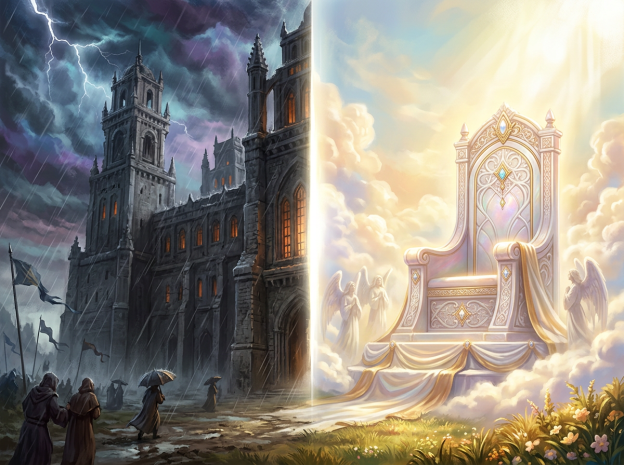
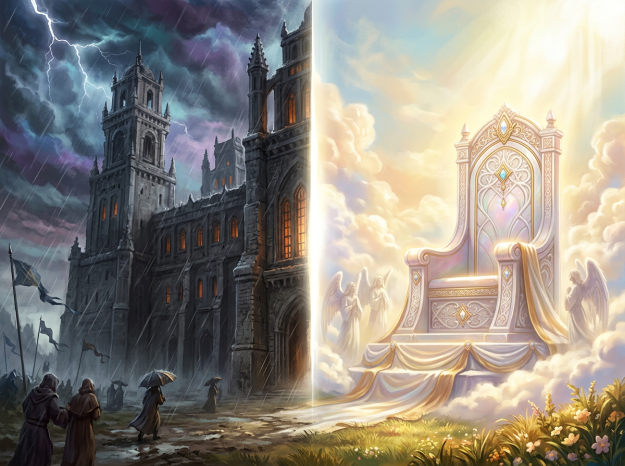
Dark rain-soaked castle and bright ornate throne with angels

The Kingdom of God and the Secular State: The Bible’s Vision of Final Victory

Jesus Christ preached the Kingdom of God as the central message of His ministry. In the Gospels, He declared, “The kingdom of God is at hand” (Mark 1:15), calling people to repentance, faith, and loyalty to God above all earthly powers. Yet Jesus preached in a world dominated by the Roman Empire, a secular state that claimed political authority and demanded civic obedience. The intersection between the Kingdom of God and the secular state reveals both tension and distinction: earthly governments possess temporary authority, while God’s Kingdom is eternal and destined for final victory.

The Bible teaches that secular governments have a legitimate, though limited, role in maintaining order. In Romans 13:1–4, the Apostle Paul states that governing authorities are “established by God” to reward good and restrain evil. Jesus Himself acknowledged civil authority when He said, “Render to Caesar the things that are Caesar’s, and to God the things that are God’s” (Matthew 22:21). This statement established a distinction between earthly government and divine sovereignty. Christians are called to respect laws and authorities insofar as they do not contradict God’s commands.

However, the Kingdom of God transcends every secular state because its source is divine rather than human. Jesus told Pontius Pilate, “My kingdom is not of this world” (John 18:36). Unlike earthly empires built through military force, wealth, or political domination, God’s Kingdom advances through truth, righteousness, and spiritual transformation. The Beatitudes in Matthew 5 describe citizens of this Kingdom as humble, merciful, pure in heart, and peacemakers. This creates an inevitable tension whenever the values of the secular state oppose the will of God.

Throughout history, governments have often resisted God’s authority. In Acts 5:29, Peter and the apostles declared, “We must obey God rather than men,” after being ordered by authorities to stop preaching Christ. The Bible therefore teaches that the state is not absolute. Human governments rise and fall, but God’s Kingdom remains forever. The prophet Daniel interpreted King Nebuchadnezzar’s vision by declaring that earthly kingdoms would eventually be replaced by God’s everlasting reign: “The God of heaven will set up a kingdom that shall never be destroyed” (Daniel 2:44).

Dark rain-soaked castle and bright ornate throne with angels
A stormy dark castle contrasts with a radiant throne in the clouds.

Contemporary governments and the emerging international order, which increasingly seek global political and economic unity, are also subject to biblical prophecy. Scripture teaches that any human system attempting to elevate itself above God’s authority will ultimately be overcome and brought into submission under Christ’s reign. Revelation 17–18 describes the downfall of global political and economic powers, while Daniel 7:14 declares that authority and dominion are given to the Son of Man so that “all peoples, nations, and languages should serve him.” Thus, the Bible teaches that even a future worldwide order will not withstand the final establishment of the Kingdom of God.

The final victory of God’s Kingdom is one of the Bible’s central promises. Revelation 11:15 proclaims, “The kingdom of the world has become the kingdom of our Lord and of his Christ, and he shall reign forever and ever.” This verse points to the culmination of history when Christ returns to judge evil and establish perfect justice. Similarly, Philippians 2:10–11 declares that every knee will bow and every tongue confess that Jesus Christ is Lord. Earthly powers may resist God temporarily, but Scripture consistently teaches that they cannot prevail against His eternal rule.

The Bible concludes with a vision of a renewed creation where God reigns fully among His people (Revelation 21:1–4). In that final Kingdom, there will be no corruption, injustice, or death. The secular state, with all its limitations, is temporary; the Kingdom of God is everlasting. Jesus’ message therefore calls believers to live faithfully within earthly societies while placing their ultimate hope in the coming reign of God, whose victory is certain and eternal.