
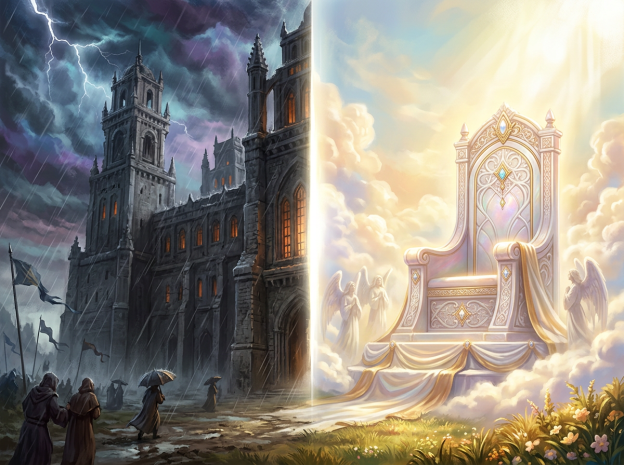
Jesus Christ preached the Kingdom of God as the central message of His ministry. In the Gospels, He declared, “The kingdom of God is at hand” (Mark 1:15), calling people to repentance, faith, and loyalty to God above all earthly powers. Yet Jesus preached in a world dominated by the Roman Empire, a secular state that claimed political authority and demanded civic obedience. The intersection between the Kingdom of God and the secular state reveals both tension and distinction: earthly governments possess temporary authority, while God’s Kingdom is eternal and destined for final victory.
The Bible teaches that secular governments have a legitimate, though limited, role in maintaining order. In Romans 13:1–4, the Apostle Paul states that governing authorities are “established by God” to reward good and restrain evil. Jesus Himself acknowledged civil authority when He said, “Render to Caesar the things that are Caesar’s, and to God the things that are God’s” (Matthew 22:21). This statement established a distinction between earthly government and divine sovereignty. Christians are called to respect laws and authorities insofar as they do not contradict God’s commands.
However, the Kingdom of God transcends every secular state because its source is divine rather than human. Jesus told Pontius Pilate, “My kingdom is not of this world” (John 18:36). Unlike earthly empires built through military force, wealth, or political domination, God’s Kingdom advances through truth, righteousness, and spiritual transformation. The Beatitudes in Matthew 5 describe citizens of this Kingdom as humble, merciful, pure in heart, and peacemakers. This creates an inevitable tension whenever the values of the secular state oppose the will of God.
Throughout history, governments have often resisted God’s authority. In Acts 5:29, Peter and the apostles declared, “We must obey God rather than men,” after being ordered by authorities to stop preaching Christ. The Bible therefore teaches that the state is not absolute. Human governments rise and fall, but God’s Kingdom remains forever. The prophet Daniel interpreted King Nebuchadnezzar’s vision by declaring that earthly kingdoms would eventually be replaced by God’s everlasting reign: “The God of heaven will set up a kingdom that shall never be destroyed” (Daniel 2:44).
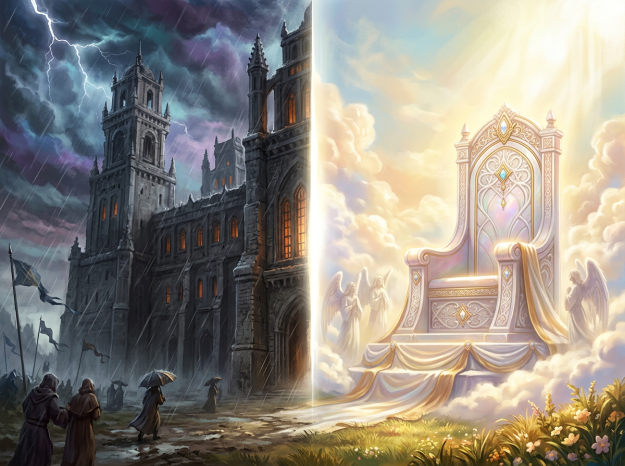
Contemporary governments and the emerging international order, which increasingly seek global political and economic unity, are also subject to biblical prophecy. Scripture teaches that any human system attempting to elevate itself above God’s authority will ultimately be overcome and brought into submission under Christ’s reign. Revelation 17–18 describes the downfall of global political and economic powers, while Daniel 7:14 declares that authority and dominion are given to the Son of Man so that “all peoples, nations, and languages should serve him.” Thus, the Bible teaches that even a future worldwide order will not withstand the final establishment of the Kingdom of God.
The final victory of God’s Kingdom is one of the Bible’s central promises. Revelation 11:15 proclaims, “The kingdom of the world has become the kingdom of our Lord and of his Christ, and he shall reign forever and ever.” This verse points to the culmination of history when Christ returns to judge evil and establish perfect justice. Similarly, Philippians 2:10–11 declares that every knee will bow and every tongue confess that Jesus Christ is Lord. Earthly powers may resist God temporarily, but Scripture consistently teaches that they cannot prevail against His eternal rule.
The Bible concludes with a vision of a renewed creation where God reigns fully among His people (Revelation 21:1–4). In that final Kingdom, there will be no corruption, injustice, or death. The secular state, with all its limitations, is temporary; the Kingdom of God is everlasting. Jesus’ message therefore calls believers to live faithfully within earthly societies while placing their ultimate hope in the coming reign of God, whose victory is certain and eternal.

